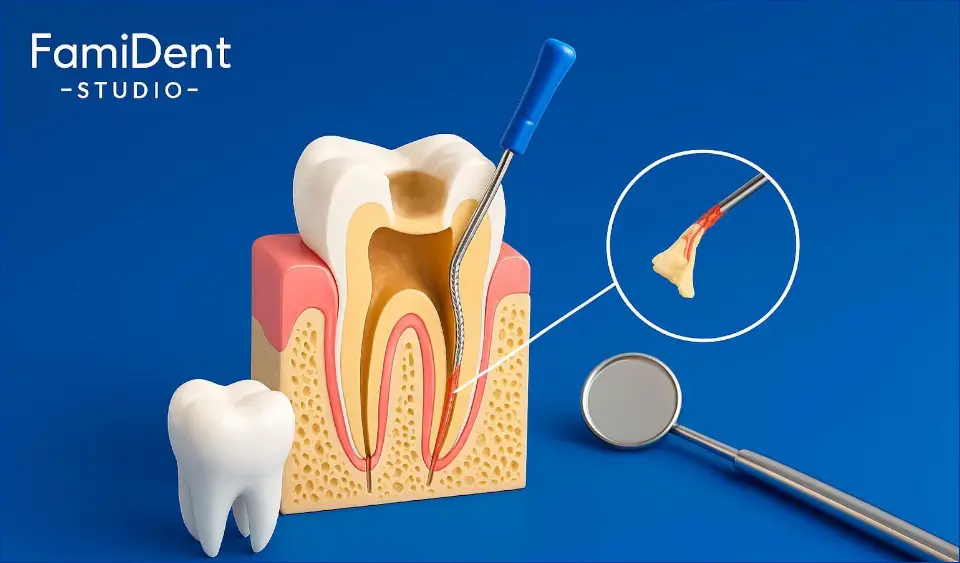
After root canal treatment, the tooth is considered depulped, meaning it no longer contains a nerve. Although the pain disappears and the inflammation resolves, the tooth itself is changing from the inside and needs additional protection.
Many patients mistakenly believe that after treatment the tooth is completely restored, but in fact it becomes more fragile and needs proper restoration of function.
What happens to a tooth after nerve removal?
After endodontic treatment, natural changes occur in the tooth that are not always immediately noticeable:
- 🦷 Decreased strength
Without nutrition from within, tooth tissues gradually lose elasticity and become more fragile. - 🎨 Color change
Over time, a depulped tooth may darken, which is a common occurrence after root canal treatment. - ⚠️ Increased risk of chips and cracks
Especially if the tooth had significant decay before treatment or is subjected to heavy chewing load.
Is a simple filling enough?
Restoration of a tooth after nerve removal depends on the extent of its destruction before treatment. In some cases, a high-quality filling is sufficient, but often this is not enough for long-term stability.
If the walls of the tooth are severely weakened, the filling cannot always evenly distribute the chewing load, which increases the risk of repeated destruction.
When is a crown recommended?
In many clinical cases, dentists recommend installing a crown after root canal treatment. This allows you to significantly extend the life of the tooth.
- protects a weakened tooth from cracks and chips 👑
- evenly distributes chewing load
- restores the function and anatomical shape of the tooth
- reduces the risk of re-treatment
Important to know
The decision to install a crown is always made individually. The doctor assesses the condition of the tooth, the extent of its destruction, the quality of the canal filling, and the overall load on the bite.
In some cases, a filling or inlay is sufficient, but with significant decay, a crown is the most reliable option.
Conclusion
A tooth after nerve removal can be preserved for many years if it is properly restored and protected from overload. A timely crown or high-quality restoration can avoid cracks and tooth loss in the future.
At FamiDent Studio, we always choose an individual solution to preserve the tooth for as long and safely as possible.