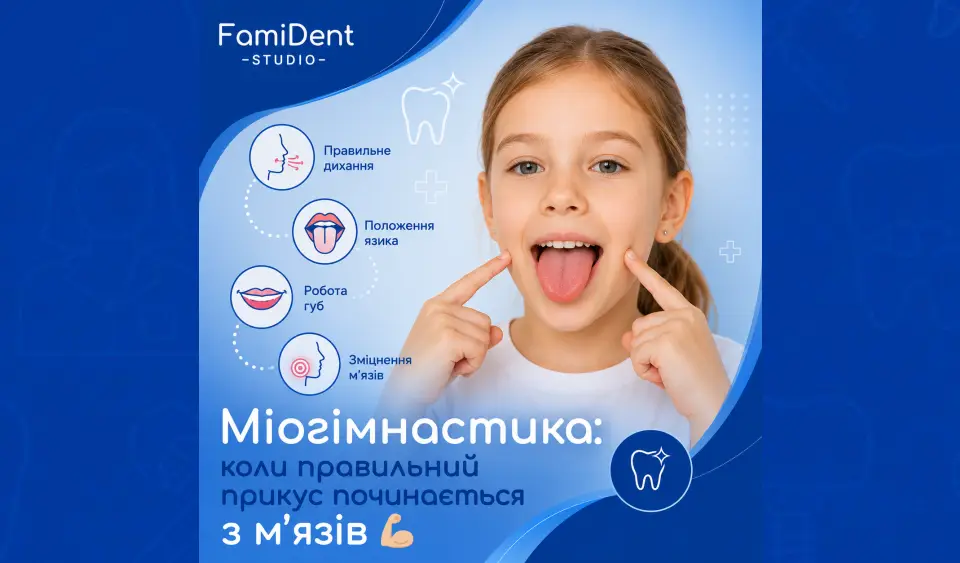
When we talk about bite, we most often think of the teeth. But their position depends not only on how they erupt. The tongue, lips, chewing and other muscles of the maxillofacial area also play an important role.
If these structures are not working properly, it can affect the formation of the dentition, the position of the tongue, and the functions of swallowing and breathing. That is why in some cases, orthodontic treatment is supplemented with myogymnastics .
At FamiDent studio in Kharkiv, we consider the bite comprehensively: it is important to assess not only the position of the teeth, but also the functions that may affect it.
What is myogymnastics? 👅
Myogymnastics is a set of specially selected exercises for the muscles of the face and oral cavity. Their goal is to help form or restore correct functions related to the work of the tongue, lips, and maxillofacial muscles.
Depending on the individual situation, exercises can be aimed at:
- correct tongue position;
- the work of the lips and muscles around the mouth;
- formation of the correct type of swallowing;
- normalization of some respiratory functions;
- improving coordination of the muscles of the maxillofacial area.
It is important to understand: myogymnastics is not a universal method for correcting any bite. Its feasibility is determined by a specialist after examination and diagnosis.
When might a child need myogymnastics?
An orthodontist may recommend special exercises as part of a comprehensive treatment if functional disorders are identified that may affect the formation of the bite.
Most often, myogymnastics can be used for:
- certain malocclusions in children;
- incorrect position of the tongue;
- swallowing disorders;
- in some cases of mouth breathing;
- dysfunction of the muscles of the maxillofacial region;
- the need to consolidate the results of comprehensive orthodontic treatment.
It is especially important not to determine the need for exercises on your own. The same symptom can have different causes, so a correct assessment of the child's condition is necessary first.
Why does tongue position matter?
The tongue is constantly in contact with various parts of the oral cavity and participates in important functions, including swallowing and speech.
If the position of the tongue or the nature of swallowing differs from physiological, this can create additional stress on the dentition and affect the formation of the bite.
Therefore, during orthodontic diagnostics, it is important to assess not only how evenly the teeth are arranged, but also their functional features.
Myogymnastics and orthodontic treatment
In some cases, exercises alone are not enough, just as orthodontic treatment itself does not always solve the functional problem.
That is why myogymnastics can be part of a comprehensive approach together with other methods of orthodontic treatment .
Depending on the child's age and situation, various orthodontic methods may be recommended, such as orthodontic plates or other designs.
If your child has already had braces, proper muscle function and following your specialist's recommendations can also be an important part of the period after active treatment.
What effect can myogymnastics give? 💪🏻
The outcome depends on the cause of the disorder, the child's age, the regularity of the exercises, and the overall treatment plan.
With a properly selected program, myogymnastics can help:
- to form a more correct position of the tongue;
- improve muscle coordination;
- maintain proper swallowing functions;
- improve the function of the lips and maxillofacial muscles;
- complement orthodontic treatment;
- help consolidate established functional skills.
At the same time, you should not expect quick results after a few classes. Myogymnastics requires systematicity and correct execution of exercises.
Why shouldn't you take exercises from the Internet?
It's easy to find dozens of exercises for the tongue and facial muscles online. But the problem is that not every exercise is suitable for a particular child.
An incorrectly selected complex may simply be ineffective, and in some situations, may not respond to the root cause of the disorder.
Therefore, first the doctor conducts an examination, assesses the bite and functions, and only then determines whether the child needs myogymnastics and which exercises will be appropriate.
Where does orthodontic care for a child begin?
The first step is not exercises, but a consultation with a dentist and a comprehensive assessment of the condition of the oral cavity.
During the examination, the specialist may pay attention to:
- position and development of teeth;
- the nature of the closure of the dentition;
- tongue position;
- the work of the lips and facial muscles;
- swallowing features;
- type of breathing;
- other factors that can affect the formation of the bite.
If necessary, the doctor may prescribe additional diagnostics and create an individual treatment plan.
Myogymnastics at FamiDent studio 🦷
At FamiDent studio in Kharkiv, we strive to work not only with the consequences, but also to look for factors that can affect the condition of the teeth and bite.
If you notice that your child is swallowing incorrectly, often breathing through their mouth, holding their tongue in an unusual position, or you have questions about the formation of their bite, it is better not to wait until the problem becomes more pronounced.